Showing posts with label Security Testing. Show all posts
Showing posts with label Security Testing. Show all posts
Saturday, March 16, 2013


Thursday, November 17, 2011
Wednesday, October 13, 2010
Web Security Scanner Evaluation Criteria
Web Application Security Scanner Evaluation Criteria
Web Application Security Scanners are complex software programs that can be challenging to evaluate, by considering following criteria's once can choose the best tool suitable for your application. The below attached link contains links to threat classification, different scanners available in the market etc. It is a good reference material for people working on web application security.
1 - Protocol Support
2 - Authentication
3 - Session Management
4 - Crawling
5 - Parsing
6 - Testing
7 - Command and Control
8 - Reporting
Select this link to read the complete document.
---
Web Application Security Scanners are complex software programs that can be challenging to evaluate, by considering following criteria's once can choose the best tool suitable for your application. The below attached link contains links to threat classification, different scanners available in the market etc. It is a good reference material for people working on web application security.
1 - Protocol Support
2 - Authentication
3 - Session Management
4 - Crawling
5 - Parsing
6 - Testing
7 - Command and Control
8 - Reporting
Select this link to read the complete document.
---
Tuesday, August 24, 2010
Security Testing - Design Guidelines for Secure Web Applications
Security Testing - Design Guidelines for Secure Web Applications
I would suggest to read this article before conducting security test. This will help you understand how and where to check for application vulnerabilities. You can create a check-list and record whether developers are following the below mentioned practices.
Web applications present designers and developers with many challenges. The stateless nature of HTTP means that tracking per-user session state becomes the responsibility of the application. As a precursor to this, the application must be able to identify the user by using some form of authentication. Given that all subsequent authorization decisions are based on the user's identity, it is essential that the authentication process is secure and that the session handling mechanism used to track authenticated users is equally well protected. Designing secure authentication and session management mechanisms are just a couple of the issues facing Web application designers and developers. Other challenges occur because input and output data passes over public networks. Preventing parameter manipulation and the disclosure of sensitive data are other top issues.
Attaching the screen shot that show the vulnerable places where hacker need to exploit.

Link to Microsoft site
---
I would suggest to read this article before conducting security test. This will help you understand how and where to check for application vulnerabilities. You can create a check-list and record whether developers are following the below mentioned practices.
Web applications present designers and developers with many challenges. The stateless nature of HTTP means that tracking per-user session state becomes the responsibility of the application. As a precursor to this, the application must be able to identify the user by using some form of authentication. Given that all subsequent authorization decisions are based on the user's identity, it is essential that the authentication process is secure and that the session handling mechanism used to track authenticated users is equally well protected. Designing secure authentication and session management mechanisms are just a couple of the issues facing Web application designers and developers. Other challenges occur because input and output data passes over public networks. Preventing parameter manipulation and the disclosure of sensitive data are other top issues.
Attaching the screen shot that show the vulnerable places where hacker need to exploit.

Link to Microsoft site
---
Saturday, August 21, 2010
Security Testing - Enabling HTTPS doesn’t mean your site is secure
Security Testing - Enabling HTTPS doesn’t mean your site is secure.
Many people have wrong assumption that, if the site is HTTPS, it is very secure.
HTTPS protect the data during transit over the network (Internet), but do not protect before it is sent or after it arrives at the destination.
Using this weakness, hackers can exploit the server behavior by using HPP attack, SQL injection, cross site scripting...
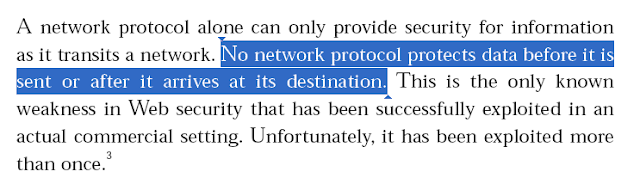
Many people have wrong assumption that, if the site is HTTPS, it is very secure.
HTTPS protect the data during transit over the network (Internet), but do not protect before it is sent or after it arrives at the destination.
Using this weakness, hackers can exploit the server behavior by using HPP attack, SQL injection, cross site scripting...

Screen shot source: SSL and TLS Essentials: Securing the Web - by Stephen A. Thomas (WILEY)
---
Friday, August 13, 2010
Security Testing - HPP Attack (HTTP Parameter Pollution)
HTTP Parameter Pollution (HPP) Attack
HPP attack can be defined as process of modifying or exploiting the REQUEST post and url parameters and changing the application behavior. It is a serious attack which is underestimated.
It is classified into Client and Server side attack.
There are may tools available to perform this attack, but it can be performed in a better way using NeoLoad, as it expose parameters, request and response in great detail. Actually it is a load testing tool, you can download the trial version and play with it. It automatically handle session and cookies, just need to concentrate on tweaking the parameters. Attaching the tool screen shot displaying parameters, request and response for a request.

Following articles will help you under stand HPP in a better way.
Minded Security Blog
Minded Security Blog - Client side attack
HPP attach on Yahoo Mail
---
HPP attack can be defined as process of modifying or exploiting the REQUEST post and url parameters and changing the application behavior. It is a serious attack which is underestimated.
It is classified into Client and Server side attack.
There are may tools available to perform this attack, but it can be performed in a better way using NeoLoad, as it expose parameters, request and response in great detail. Actually it is a load testing tool, you can download the trial version and play with it. It automatically handle session and cookies, just need to concentrate on tweaking the parameters. Attaching the tool screen shot displaying parameters, request and response for a request.

Following articles will help you under stand HPP in a better way.
Minded Security Blog
Minded Security Blog - Client side attack
HPP attach on Yahoo Mail
---
Tuesday, July 6, 2010
Tuesday, June 22, 2010
Web Application Security Test
Web Application Security Test
Definition: Application security is the use of software, hardware, and procedural methods to protect applications from external threats. Security measures built into applications and a sound application security routine minimize the likelihood that hackers will be able to manipulate applications and access, steal, modify, or delete sensitive data. Once an afterthought in software design, security is becoming an integral part of the design process.
Following are different tests to check the application security.
Data injection and manipulation attacks.
1. Reflected cross site scripting. (XSS).
2. Persistent XSS.
3. Cross site request forgery.
4. SQL Injection.
5. Blind SQL injection.
6. Buffer overflows.
7. Integer overflows.
8. Log injection.
9. Remote file include (RFI) injection.
10. Server side include (SSI) injection.
11. Operating command injection.
12. Local file include (LFI)
13. Parameter Redirection.
14. Auditing of redirect chains.
Sessions and authentications
1. Session strength.
2. Authentication attack.
3. Insufficient authentication.
4. Insufficient session expiration.
Server and general HTTP
1. AJAX auditing.
2. FLASH analysis.
3. HTTP header auditing.
4. Detection of client side technologies.
5. Secure sockets layer (SSL) certificate issues.
6. SSL protocol supported.
7. SSL ciphers supported.
8. Server misconfiguration.
9. Directory indexing and enumeration.
10. Denial of service.
11. HTTP response splitting.
12. Windows 8.3 file name.
13. DOS device handle DoS.
14. Canonicalization attacks.
15. URL redirection attack.
16. Password auto complete.
17. Custom fuzzing.
18. Path Manipulation - traversal.
19. Path truncation.
20. WebDEV auditing.
21. Web services auditing.
22. File enumeration.
23. Information disclosure.
24. Directory and path traversal.
25. Spam gateway detection.
26. Brute force authentication attack.
27. Known application and platform vulnerabilities.
Source: HP WebInspect.
One of the best site for understanding different threats, select this link.
List of tools available in the market.
OWASP Security Testing Tools Listing
HP WebInspect
IBM Rational AppScan
Powerfuzzer
SecPoint Penetrator
Netsparker
ZeroDayScan
Fortify 360
OWASP Security Testing Tools
Retina Web Security Scanner
Hailstorm
GamaSec
Wikto
Nikto Scanner
Acunetix Web Vulnerability Scanner
Defensics Core Internet Test Suite
Perimeter Check
Core Impact Pro
C5 Compliance Platform
Snort
SecurityMetrics Appliance
Nessus
Security Center
SARA
Qualys Free Security Scans
GFiLANguard
Qualys Guard
PatchLink Scan
Secure-Me
SAINT
NMap Network Mapper -
NetIQ Security Analyzer
Foundstone
CERIAS Security Archive
StopBadware Vulnerability Scanner list
----
Definition: Application security is the use of software, hardware, and procedural methods to protect applications from external threats. Security measures built into applications and a sound application security routine minimize the likelihood that hackers will be able to manipulate applications and access, steal, modify, or delete sensitive data. Once an afterthought in software design, security is becoming an integral part of the design process.
Following are different tests to check the application security.
Data injection and manipulation attacks.
1. Reflected cross site scripting. (XSS).
2. Persistent XSS.
3. Cross site request forgery.
4. SQL Injection.
5. Blind SQL injection.
6. Buffer overflows.
7. Integer overflows.
8. Log injection.
9. Remote file include (RFI) injection.
10. Server side include (SSI) injection.
11. Operating command injection.
12. Local file include (LFI)
13. Parameter Redirection.
14. Auditing of redirect chains.
Sessions and authentications
1. Session strength.
2. Authentication attack.
3. Insufficient authentication.
4. Insufficient session expiration.
Server and general HTTP
1. AJAX auditing.
2. FLASH analysis.
3. HTTP header auditing.
4. Detection of client side technologies.
5. Secure sockets layer (SSL) certificate issues.
6. SSL protocol supported.
7. SSL ciphers supported.
8. Server misconfiguration.
9. Directory indexing and enumeration.
10. Denial of service.
11. HTTP response splitting.
12. Windows 8.3 file name.
13. DOS device handle DoS.
14. Canonicalization attacks.
15. URL redirection attack.
16. Password auto complete.
17. Custom fuzzing.
18. Path Manipulation - traversal.
19. Path truncation.
20. WebDEV auditing.
21. Web services auditing.
22. File enumeration.
23. Information disclosure.
24. Directory and path traversal.
25. Spam gateway detection.
26. Brute force authentication attack.
27. Known application and platform vulnerabilities.
Source: HP WebInspect.
One of the best site for understanding different threats, select this link.
List of tools available in the market.
OWASP Security Testing Tools Listing
HP WebInspect
IBM Rational AppScan
Powerfuzzer
SecPoint Penetrator
Netsparker
ZeroDayScan
Fortify 360
OWASP Security Testing Tools
Retina Web Security Scanner
Hailstorm
GamaSec
Wikto
Nikto Scanner
Acunetix Web Vulnerability Scanner
Defensics Core Internet Test Suite
Perimeter Check
Core Impact Pro
C5 Compliance Platform
Snort
SecurityMetrics Appliance
Nessus
Security Center
SARA
Qualys Free Security Scans
GFiLANguard
Qualys Guard
PatchLink Scan
Secure-Me
SAINT
NMap Network Mapper -
NetIQ Security Analyzer
Foundstone
CERIAS Security Archive
StopBadware Vulnerability Scanner list
----
Subscribe to:
Posts (Atom)


 Posts
Posts


